©2026 The Jacob and Gwendolyn Knight Lawrence Foundation, Seattle/Artists Rights Society (ARS), New York
Jacob Lawrence
Jacob Lawrence occupies a singular position in twentieth-century American art. Born in Atlantic City, New Jersey in 1917 to parents who had migrated north in the years following the First World War, Lawrence moved to Harlem with his mother in 1930, arriving at the height of the Harlem Renaissance. The extraordinary cultural environment he encountered there – where art, literature, music, and political thought converged – would profoundly shape both his visual language and his commitment to chronicling the African American experience.
As a young artist, Lawrence studied with Charles Alston at the Utopia Children’s House and later worked alongside Alston and Henry Bannarn at Studio 306, an important gathering place for Harlem’s artists, writers, actors, and musicians. From these formative years Lawrence developed the distinctive pictorial vocabulary that would define his career: flattened space, angular forms, carefully orchestrated color, and an exceptional ability to distill complex human narratives into compositions of remarkable clarity and emotional force.
Lawrence achieved national recognition at an extraordinarily young age. In 1941, working with Gwendolyn Knight, whom he married later that year, he completed the sixty panels of The Migration of the Negro, now known as The Migration Series. The project transformed Lawrence’s career. Fortune magazine reproduced twenty-six panels, and the Museum of Modern Art and the Phillips Collection ultimately divided the series between their collections. By the end of that year, Lawrence had joined Edith Halpert’s Downtown Gallery, becoming the first African American artist represented by a major New York commercial gallery.
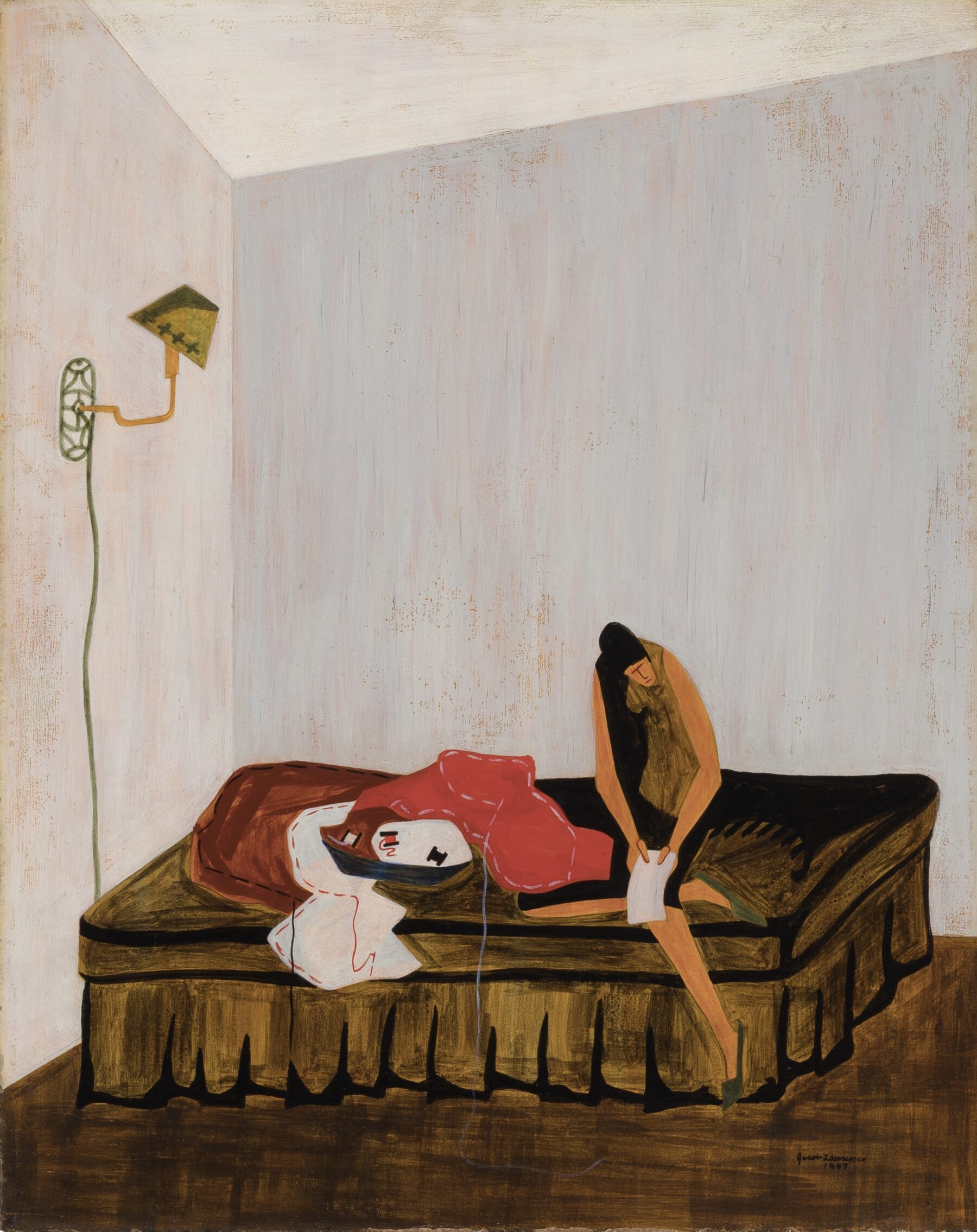
Painted only six years later, Letter from Home belongs to a particularly important moment in Lawrence’s development. The work retains the narrative power of his great historical series while turning toward a more intimate and psychologically concentrated subject. A solitary woman sits on the edge of a bed, her needlework momentarily abandoned as she bends toward the letter held in her hands. Lawrence strips the interior to its essentials: a bed, a wall-mounted lamp, a few personal belongings, and the enveloping geometry of the room. Within this deliberately spare setting, the smallest gestures assume tremendous emotional weight.
The painting’s power lies in this economy. Lawrence reduces the figure and surrounding space to angular planes and flattened shapes, yet the scene is anything but emotionally flat. The woman’s bowed head, elongated arm, and downward gaze create a quiet tension between anticipation and reflection. Against the pale, almost austere walls, concentrated passages of red, ochre, olive, and black give the figure and bed an extraordinary visual presence. The emptiness surrounding her becomes an active component of the composition, heightening the sense of isolation while directing attention toward the unseen contents of the letter.
The subject also connects Letter from Home directly to Lawrence’s wartime and immediate postwar imagery. The painting was initially exhibited by the Downtown Gallery under the title Letter from Europe, and its narrative bears a compelling relationship to The Letter from Lawrence’s War Series in the collection of the Whitney Museum of American Art.
When the War Series was exhibited at the Downtown Gallery in December 1947, Lawrence described his intention with unusual clarity: “In approaching this subject, I tried to capture the essence of war…the feelings and emotions that are felt by the individual – both fighter and civilian. A wife or a mother receiving a letter from overseas…” The statement gives Letter from Home particular resonance. Rather than treating war through battle or spectacle, Lawrence concentrates on its private emotional consequences – distance, uncertainty, waiting, and the fragile connection carried by a letter. In this quiet interior, the experience of war is distilled into a single human gesture. (Jacob Lawrence, statement for War, Downtown Gallery, December 1947; Downtown Gallery records, Archives of American Art, Smithsonian Institution, Artist Files A-Z, Reel 5549, Frame 455.)
More than seventy-five years after it was painted, Letter from Home remains strikingly immediate. Lawrence transforms an ordinary private moment into something universal: the experience of waiting, receiving news, and maintaining human connection across distance. It is precisely this union of formal discipline and emotional resonance that distinguishes Lawrence’s finest paintings – and places him among the essential American artists of the twentieth century.
Letter from Home, 1947
Tempera on hardboard
20 1/8″ x 15 7/8″
Signed and dated lower right
The artist
The Downtown Gallery, New York (as Letter from Europe)
Alan Brandt, New York
Michael Rosenfeld Gallery, New York
The Manoogian Collection, Michigan, acquired from the above in 1999
Jonathan Boos, New York
Private collection, Michigan, acquired from the above in 2009
Christie’s, New York, November 20, 2018, lot 63, estimate $250,000-$350,000, sold for $640,000 Private Collection, New York, acquired from the above
