©2026 Romare Bearden Foundation / Artists Rights Society (ARS), New York
Romare Bearden
Through his mastery of collage, Romare Bearden gave visual form to the complexities, rhythms, and resilience of Black American life in postwar America. Born to educated, middle class parents in Charlotte, North Carolina, his family and he migrated to New York City around 1914 to escape the south’s oppressive Jim Crow laws. In New York the family home became a frequent meeting place for such luminaries of the Harlem Renaissance as Langston Hughes, Duke Ellington, and W.E. Dubois. From an early age, Bearden was exposed to a variety of creative and cultural pursuits as well as to the importance of civic involvement and social activism. And while New York was Bearden’s base for the rest of his life, his ties to the south remained strong and deeply influenced his artwork.
Collage became Bearden’s defining medium, allowing him to juxtapose disparate imagery in ways that brilliantly expressed the complexities of African American life. By using the cultural symbols and traditions of his birthright as well as exposing racial stereotypes, Bearden created compositions with multiple layers of meaning. His work reveals remarkable intellectual curiosity, and the breadth of his interests defies the limits of artistic and cultural categorization.
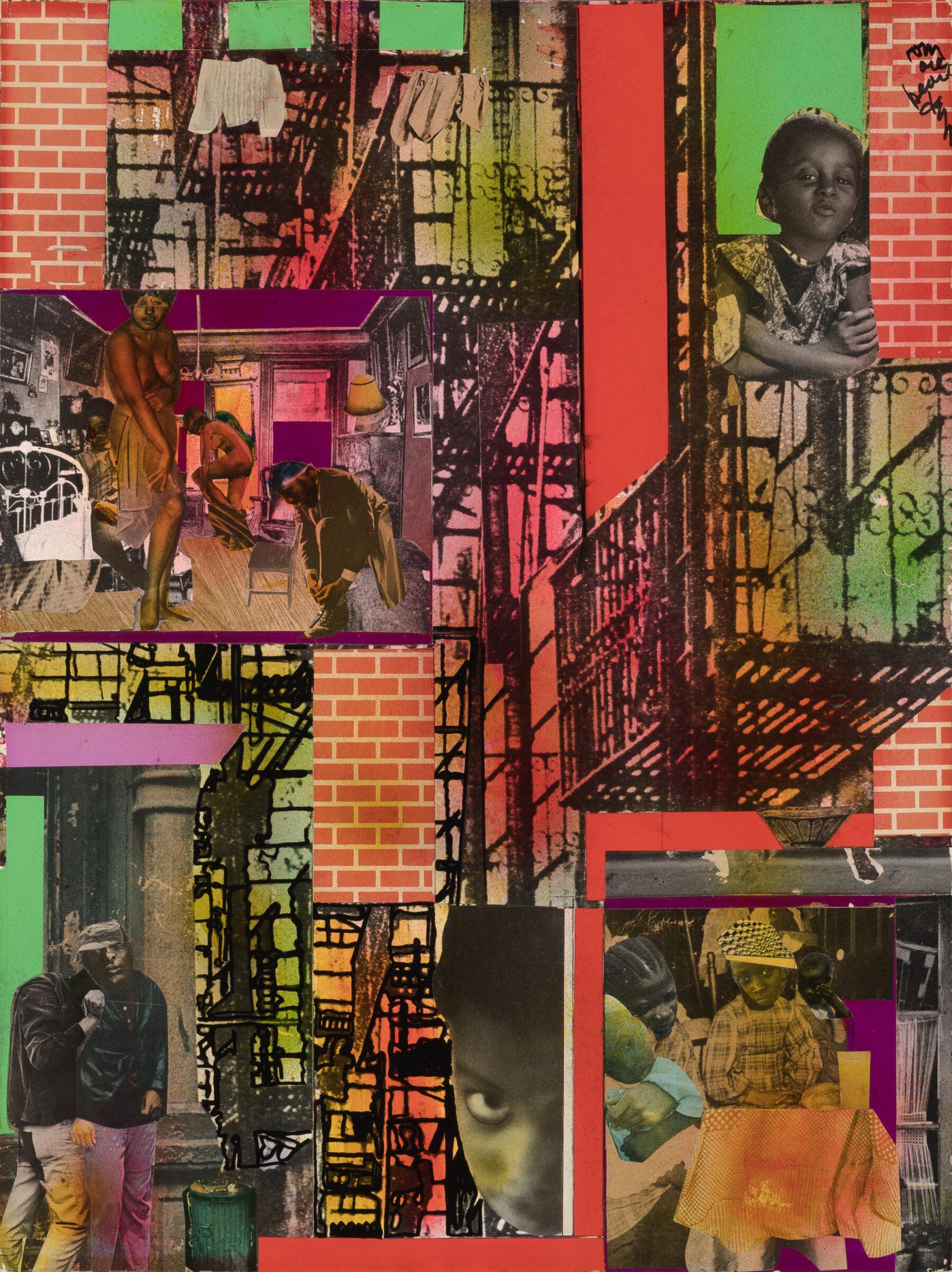
Manhattan Suite, 1975, stands among the most ambitious and visually complex achievements of Bearden’s mature collage practice. Executed during a pivotal period in Bearden’s career, the work demonstrates the extraordinary visual sophistication that established him as one of the defining American artists of the postwar era. At once intimate in scale and expansive in conception, Manhattan Suite transforms the experience of New York into a richly layered world of figures, architecture, interiors, and imagined narratives.
The complexity of Bearden’s construction is central to the work’s appeal. Bearden replaces conventional perspective with simultaneity, allowing different interiors, figures, viewpoints, and moments to coexist within a single pictorial field. Manhattan becomes less a specific place observed than a city reconstructed through memory, experience, and imagination. From an intricate accumulation of painted and printed papers, photographic imagery, drawn passages, and areas of boldly articulated color, he creates a fractured yet remarkably coherent environment. Each fragment has its own visual identity, yet every element participates in the larger composition. The eye moves constantly across the surface, discovering new relationships between forms and returning repeatedly to details that initially seem incidental. This is collage as both painting and architecture: Bearden constructs a pictorial space that can be entered, explored, and revisited.
The urban setting is particularly evocative. Manhattan Suite presents a city building seemingly opened before the viewer, revealing a series of vignettes and glimpses into private spaces. These scenes are intentionally impossible to reconcile as a conventional architectural view. They suggest looking simultaneously into rooms, windows, and apartments that could not ordinarily be seen together from a single vantage point. Bearden thus creates the imaginative equivalent of a cutaway Manhattan building—an impossible composite in which separate lives and moments unfold beside one another. The effect is cinematic and almost voyeuristic, inviting the viewer to construct stories around the figures and spaces encountered throughout the composition.
Manhattan Suite, 1975
Collage and mixed media on board
24″ x 18″
Signed upper right; Signed, titled and dated on the verso
Private European collection, acquired directly from the artist
Sotheby’s, New York, February 26, 2007, lot 75, estimate $30,000-40,000, sold for $240,000 setting a world auction record for the artist at the time.
Manoogian Collection, Taylor, Michigan, acquired from the above sale
Jonathan Boos, New York
Private Collection, New Jersey, acquired from the above in October 2013
