© 2026 Estate of Ben Shahn / Licensed by VAGA at Artists Rights Society (ARS), NY
Ben Shahn
One of the most important Social Realist artists of the 1930s and 40s, Ben Shahn was born in Lithuania and immigrated to the United States at the age of eight. His family settled in Williamsburg, Brooklyn, where they lived in a succession of row houses on Walton Street. Shahn’s impoverished childhood informed the social commentary of his paintings, which illuminate the oppression and injustices suffered by working class, minority and immigrant families during the Depression. Shahn said of the inspiration for his work, “At some point very early in my life I became absorbed—not in Man’s Fate, but rather in Man’s State. The question of suffering is an eternal mystery wearing many masks and disguises as well as its true face, but its reality impinges upon us everywhere. I am sure that to some of us it is a more deeply felt and personal burden than to others. Perhaps I am trying primitively to exorcise it by painting it; perhaps I am trying to understand it, perhaps to share it. Whatever my basic promptings and urges may be, I am aware that the concern, the compassion for suffering—feeling it, formulating it—has been the constant|intention of my work since I first picked up a paintbrush” (Jean Lipman, ed., What is American in American Art, New York, 1963, p. 95). In New York, Shahn first trained as a lithographer and his ability in lithography and graphic design can often be perceived in his paintings. His preferred medium was egg tempera, a popular medium for many of the social realists of the time, such as Paul Cadmus, Jared French, and Thomas Hart Benton. Shahn was also a graphic artist who designed posters supporting social and political causes for various organizations and media outlets.
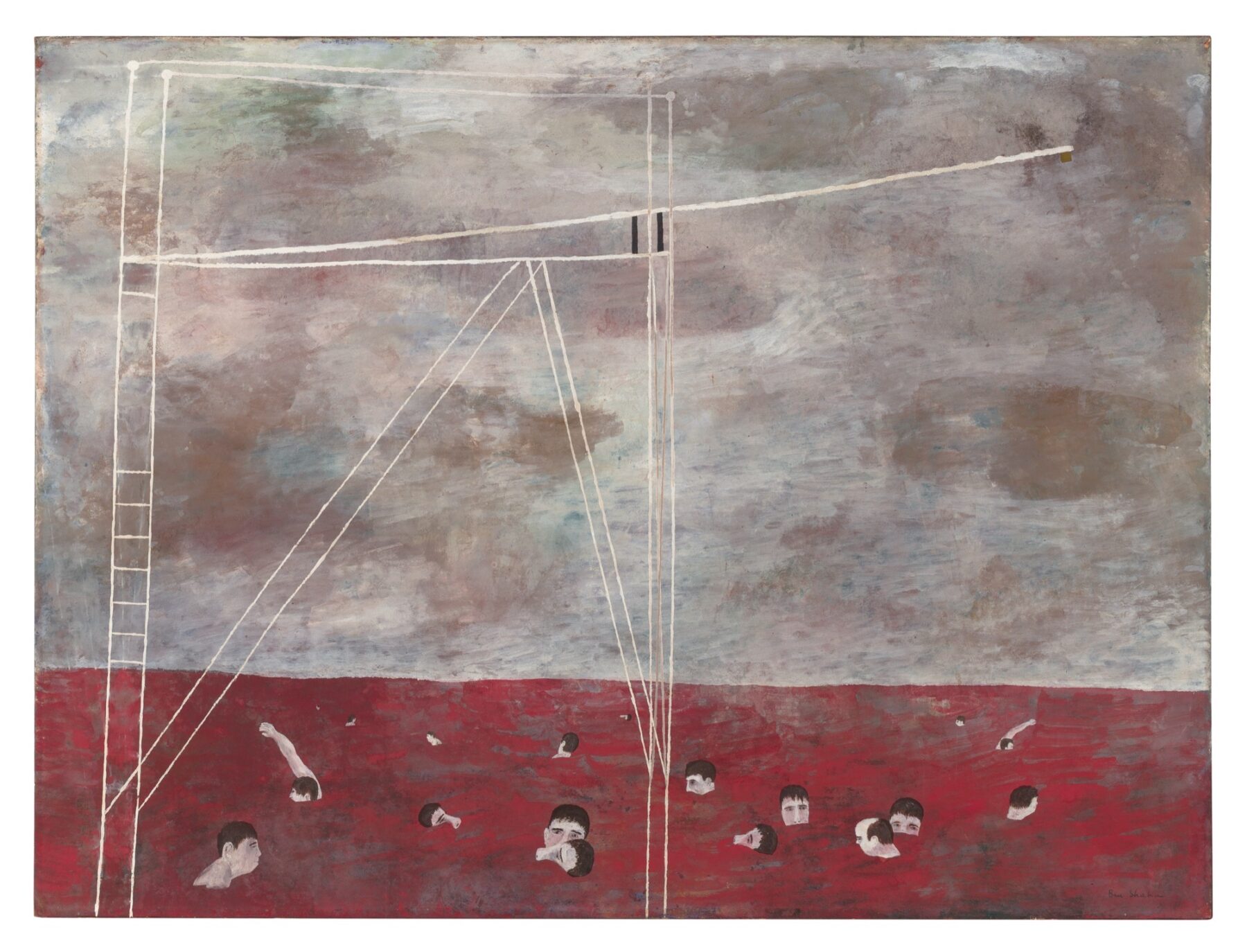
Atlantic City, 1946 was painted at a pivotal moment in Shahn’s career, when his focus began shifting from the social realism of the 1930’s and wartime propaganda work of the early 1940s toward a more symbolic, lyrical style of painting. At first glance the viewer sees a diving board and a group of figures swimming, a deceptively light scene, yet the painting is more than a depiction of a resort town that the title suggests. The work suggests Shahn’s interest in the contradictions of American Life in the immediate aftermath of World War II. Atlantic City was a place of leisure and spectacle, embodying the desire for escape and pleasure after years of deprivations. At the same time, Shahn’s stylized figures, distorted perspectives, and uneasy juxtapositions suggest a subtle critique, hinting that beneath post-war prosperity lay unresolved tensions and inequities.
In his post-WWII paintings, Shahn turned increasingly to allegory, myth and personal symbolism. The hard-edged political protest of his Depression-era work gave way to a more contemplative exploration of human resilience, suffering and hope. Leisure and festivity are present, but so is a searching quality – an acknowledgment that the world has been irreversibly altered. Atlantic City, 1946 embodies Ben Shahn’s post-WWII concerns, particularly the “emptiness and waste” he felt in the war’s aftermath, along with “the littleness of people trying to live on through the enormity of war.”
Ben Shahn
Atlantic City, 1946
Tempera on paper mounted on board
24″ x 32″
Signed lower right
Signed and inscribed “Sold 11-26-46”
Provenance
Kennedy Galleries, New York, NY
Private Collection, New York, acquired from the above in the mid 1980s