©2026 The Milton Avery Trust / Artists Rights Society (ARS), New York
Milton Avery
The success of Milton Avery’s art lies in his ability to modernize familiar scenes in nature and domestic life by transforming them into carefully orchestrated arrangements of color and form. Avery was born in Sand Bank (now Altmar), New York, in 1885 to a working-class family. By 1898, the family moved to an area near East Hartford, Connecticut, where he began formal art studies in 1905. At night, Avery took classes at the Connecticut League of Art Students while working at a factory in Hartford to help support his family. In 1918 he transferred to the School of the Art Society in Hartford to continue his arts education, which centered on the basic tenets of academic drawing as well as the work of American Impressionist artists John Henry Twachtman and Childe Hassam. Following his studies, Avery worked in a Post-Impressionist style, depicting traditional figuration and landscape subjects.
In 1924, Avery met New York artist Sally Michel during a summer trip to Gloucester, Massachusetts. The following year, Avery joined Michel in New York, and the pair wed in 1926. Avery then attended evening classes at the Art Students League and took up painting full-time. Already in his forties, Avery had the confidence to explore a range of styles through constant experimentation and a rigorous work ethic. While most American painters aligned with the American Scene movement during the 1930s, Avery’s style defied classification. His version of modernism was a blending of realism and abstraction, using color and simplified forms to create a unified whole. As Avery described, “I like to seize the one sharp instant in nature, to imprison it by means of ordered shapes and space relationships. To this end I eliminate and simplify, leaving apparently nothing but color and pattern. I am not seeking pure abstraction; rather, the purity and essence of the idea— expressed in its simplest form” (Robert Hobbs, Milton Avery [New York: Hudson Mills Press, 1990], p. 166).
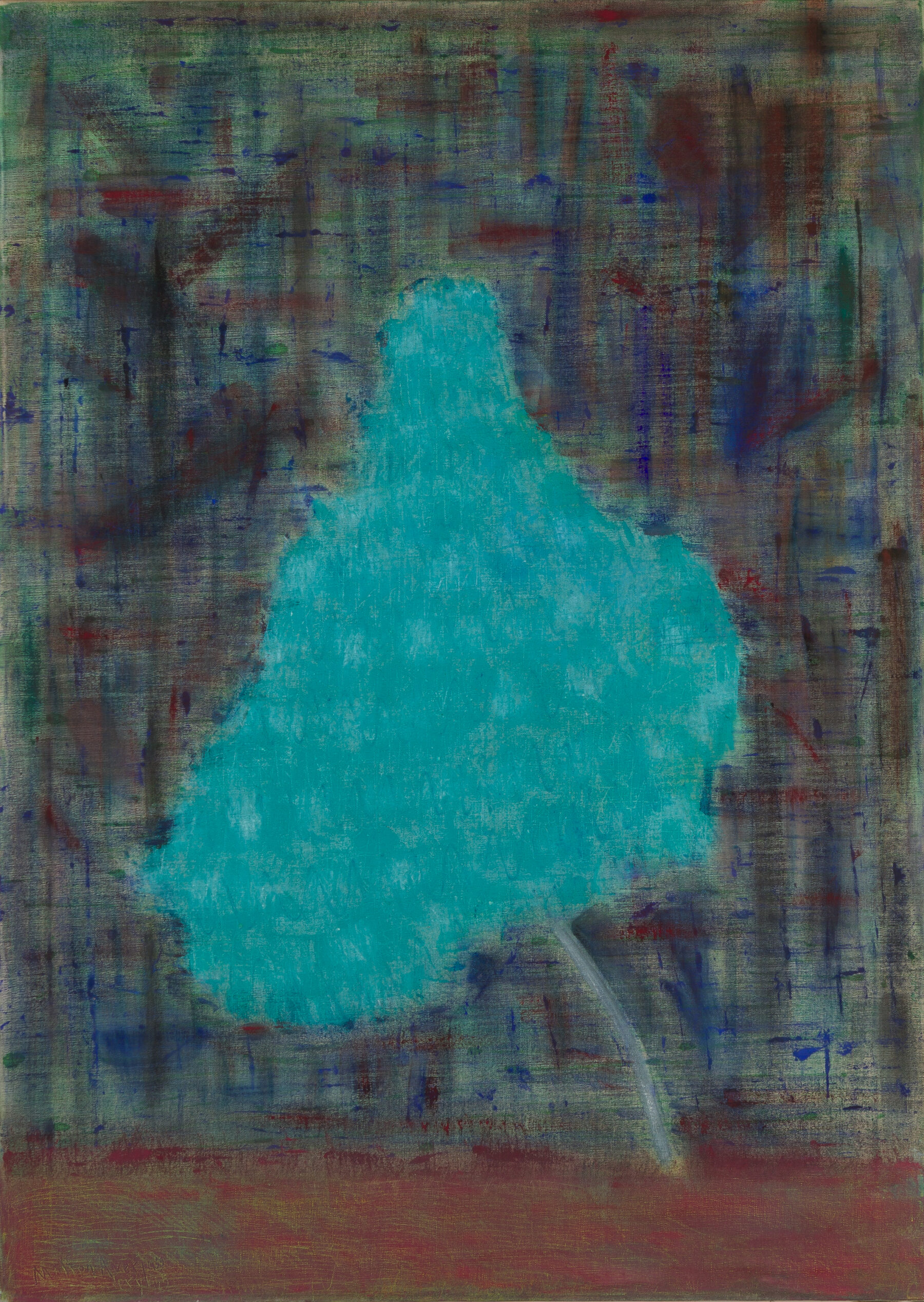
Painted in 1955, Blue Tree belongs to one of the most important periods of Milton Avery’s career, when his lifelong investigation of color, form, and the American landscape reached a remarkable level of refinement. By the mid-1950s, Avery had stripped his compositions of nearly all extraneous detail, transforming the observed world into broad, interlocking passages of color. In Blue Tree, landscape becomes less a description of a particular place than an orchestration of shape, rhythm, and chromatic harmony.
The commanding blue tree at the center of the composition is at once recognizable and emphatically abstract, functioning as both subject and dominant color form. Avery’s unexpected chromatic choices detach the landscape from naturalistic description, allowing color itself to establish space, atmosphere, and emotional resonance. The painting exemplifies the extraordinary economy and assurance that distinguish Avery’s finest works of the 1950s.
Avery’s late period paintings (1947-1963) occupy an important place in the development of postwar American art. He was a pivotal figure in the transition from European-derived modernism to the great generation of postwar American painters. His progressive simplification of landscape, figure, and still life—reducing forms to essential shapes while allowing color to assume increasing independence—provided an important precedent for the development of Abstract Expressionism and Color Field painting.
His influence on Mark Rothko was particularly profound. The two artists were close friends and Rothko deeply admired Avery’s ability to achieve emotional intensity through restraint. Avery demonstrated to Rothko that expanses of carefully calibrated color could carry emotional and expressive power independent of conventional representation.
When Avery died in January 1965, Rothko delivered a memorial address at the Society for Ethical Culture in New York. Recalling his first encounter with Avery’s work, Rothko spoke of its immediate “conviction of greatness” and remembered Avery’s importance to a generation of younger artists who were “questioning and looking for an anchor.”
Barbara Haskell states of Avery’s late period, “As the scale of his paintings increased, the devices for conveying harmony and calm…became even more accentuated. He eliminated disturbing color contrasts by building chromatic harmonies around closely allied hues, equalizing values so that even complementarians had similar intensity. The homogenous color areas of previous work now yielded to mottled effects produced either by applying uneven densities of the same color or by brushing strokes of dark color over lighter grounds. The result—shimmering rhythms within color zones. Still, each painting possessed an overall balance in which no shape or color dominated. Favoring pastel colors, Avery tinted his paint with white pigment which imparted a coolness of tone even when colors were highly saturated. This ability to create pastel color harmonies which were voluptuous and opulent was one of the distinguishing features of Avery’s late paintings.” (Barbara Haskell, Milton Avery [New York: Whitney Museum of American Art, 1982], p. 158)
Blue Tree, 1955
Oil on canvas
42 1/4″ x 30″
Signed and dated lower left; Signed, titled and dated on the verso
Estate of Sally Michel Avery
Waddington Galleries, Ltd., London
Private Collection, acquired from the above in 2007
