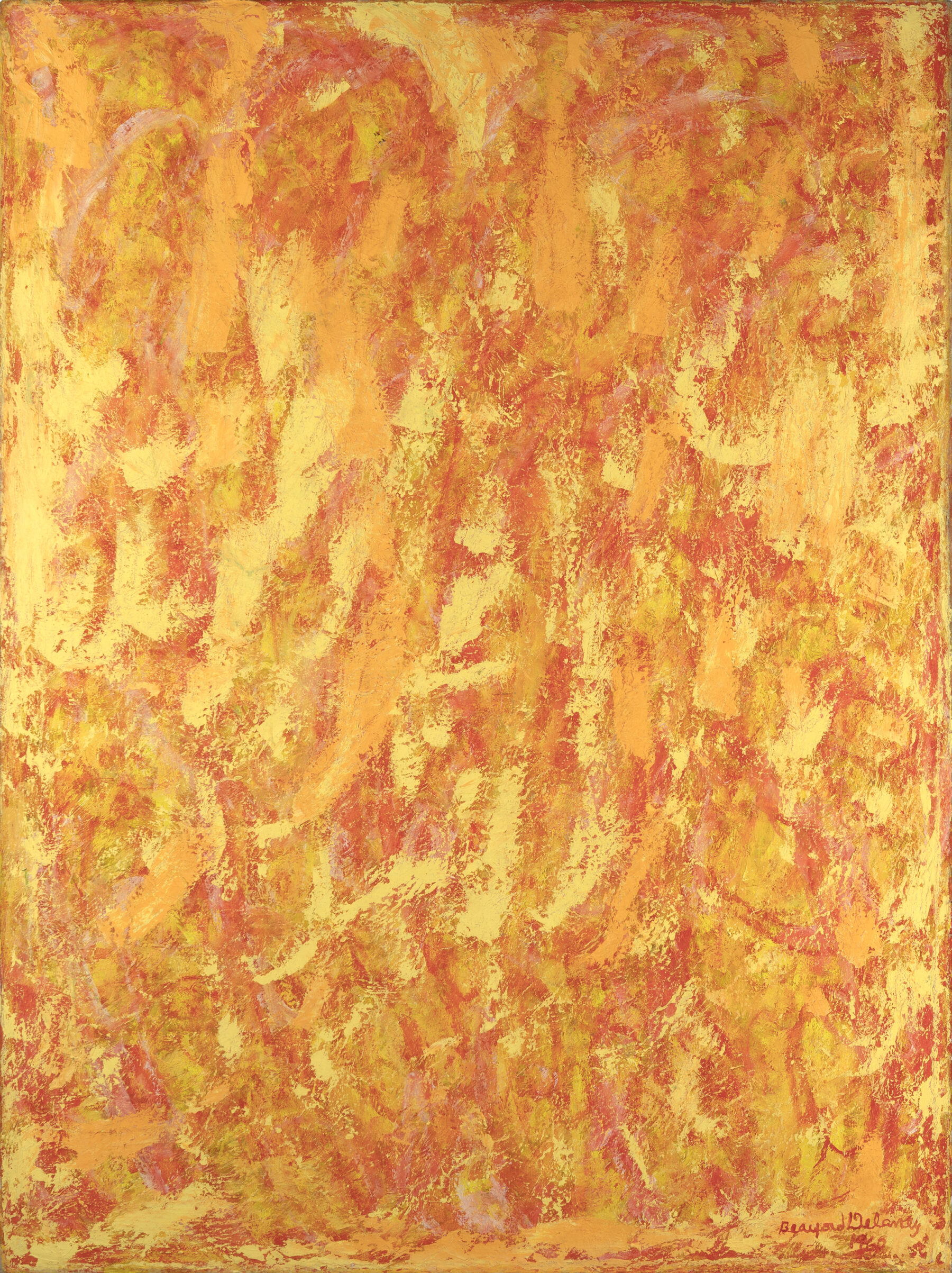
©Estate of Beauford Delaney, by permission of Derek L. Spratley, Esquire, Court Appointed Administrator, Courtesy of Michael Rosenfeld Gallery LLC, New York, NY
Beauford Delaney
Beauford Delaney stands among the most important figures in American modernism, creating a deeply personal body of work that evolved from figurative expressionism to increasingly radical forms of abstraction. Born in Knoxville, Tennessee in 1901, he was raised in a strict Christian household. His mother recognized and encouraged his artistic abilities and provided an important foundation for his artistic development. In 1923, he left the South for Boston, where he studied over the next six years at the Massachusetts Normal School, the Copley Society, the Lowell Institute, and the South Boston School of Art.
Delaney moved to New York in 1929, initially settling in Harlem, where he established an early reputation painting portraits of society women and professional dancers. Delaney featured these portraits at his first solo exhibition at the 135th Street Branch Library of the New York Public Library in 1930, and that same year three of his portraits were exhibited at the Whitney Studio Galleries, the predecessor of the Whitney Museum of American Art. He continued his studies at the Art Students League, where he worked with John Sloan and Thomas Hart Benton.
During the Depression, Delaney also worked as a muralist for the Federal Art Project, collaborating with Charles Alston on two murals at the Harlem Hospital Center. Through Alston, he became part of the influential circle of artists who gathered at Alston’s studio at 306 West 141st Street, known simply as “306”. This community included Norman Lewis, Jacob Lawrence, Augusta Savage, Romare Bearden and other leading figures of the Harlem Renaissance. At the same time, Delaney moved comfortably between Harlem and the bohemian circles of Greenwich Village, where he lived and worked from 1936-1953 at 181 Greene Street.
In 1953, Delaney left New York and permanently settled in Paris. Delaney followed the path of his friend James Baldwin, joining other African American artists who relocated to Europe in search of greater artistic freedom. Paris provided Delaney with an environment in which he could pursue his art with greater independence, and his work increasingly moved toward abstraction. His mature compositions are distinguished by vibrant color, heavily worked surfaces, and energetic brushwork.
Untitled, Paris, 1968 is an exceptional example of Beauford Delaney’s mature abstraction and a particularly powerful expression of the artist’s lifelong pursuit of light through color. The painting possesses an imposing physical presence, yet its effect is remarkably atmospheric. Delaney builds the composition through an intensely worked field of yellow, orange, red, white, and flashes of violet and rose. Colors overlap, dissolve, and reappear across the surface, creating an image that seems continually in motion. The eye is given no single point of rest; instead, it moves through passages of dense pigment and sudden illumination. The result is less the depiction of light than an attempt to make light itself palpable.
For Delaney, light carried emotional and spiritual meaning, and in the Paris abstractions it increasingly became the essential subject of his art. Yellow assumed an extraordinary importance within his vocabulary—not merely as a hue, but as a means of suggesting radiance, warmth, transcendence, and inner illumination. In Untitled, Paris, 1968, yellow and orange appear to emanate through the accumulated layers of paint, while reds and violets introduce passages of heat and counterpoint. White strokes punctuate the surface like flashes of concentrated light. Delaney’s vigorous handling of pigment gives this luminosity a physical presence: paint is dragged, layered, scumbled, and built into a richly tactile surface. The seeming spontaneity belies an extraordinarily sophisticated orchestration of color, gesture, density, and interval.
Among Delaney’s large-scale Paris abstractions, Untitled, Paris, 1968 has the chromatic intensity, painterly richness, and spiritual resonance associated with his most ambitious mature works. Abstraction allowed Delaney to move beyond the description of the visible world toward something more elusive—the sensation of light as an emotional and spiritual experience. Here, color, gesture, and surface become inseparable: the painting appears simultaneously material and immaterial, its dense impasto giving physical form to an image that seems to glow from within. It is this tension—between matter and light, physical surface and spiritual sensation—that gives Delaney’s finest abstractions their remarkable power.
Untitled, Paris, 1968
Oil on canvas
51″ x 39″
Signed and dated lower right; Signed and dated on the verso
The artist
Philippe Briet, Inc., New York
Private Collection, New York and Paris, acquired from the above in 1991
