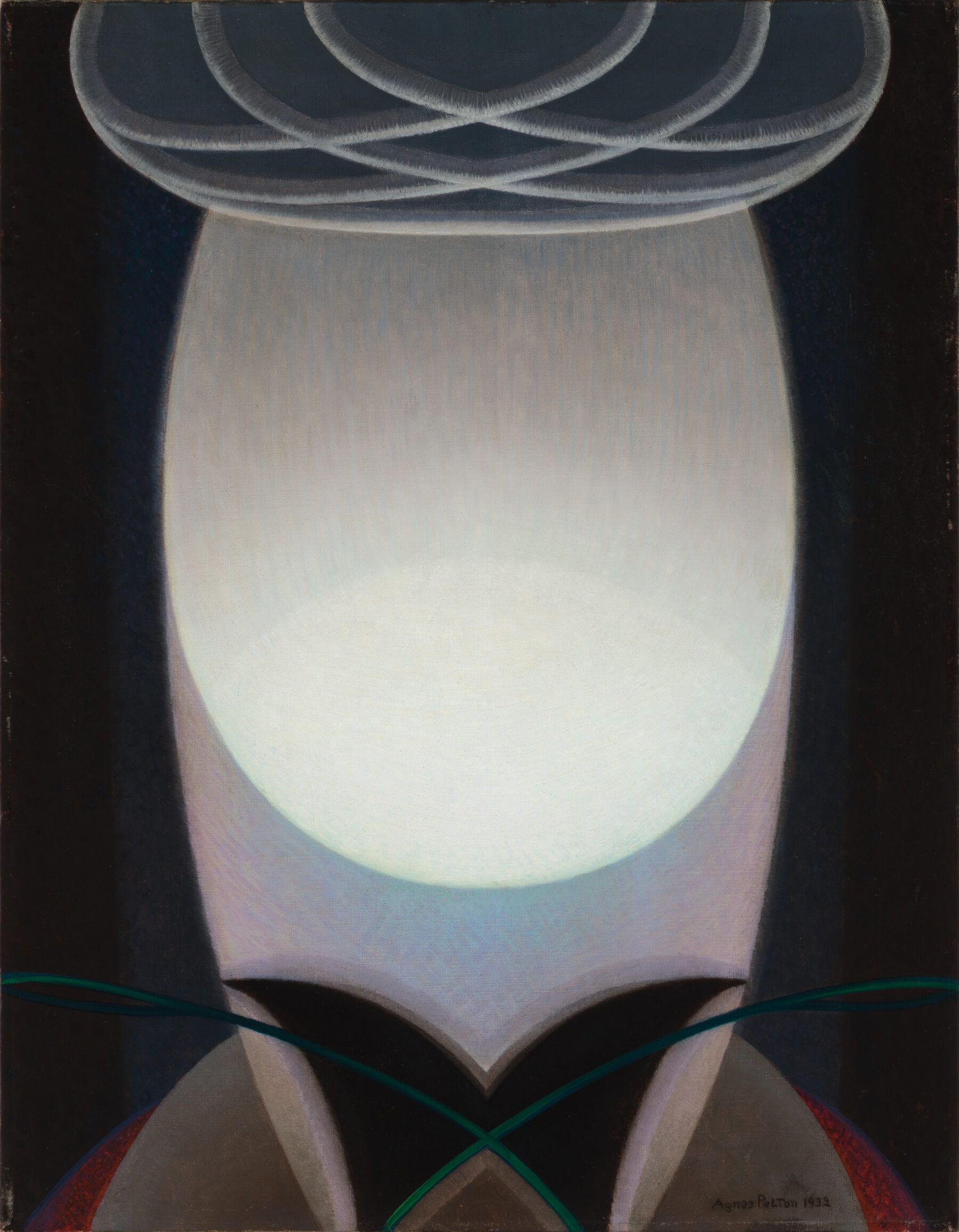
Agnes Pelton
Agnes Pelton was a visionary modernist whose abstract paintings of the desert landscape embodied her spiritual beliefs. Pelton was born in 1881 to American parents in Stuttgart, Germany. The family briefly lived in Switzerland before returning to the United States in 1888. Pelton and her family settled in Brooklyn, and at just fourteen, she enrolled in a general art course at the Pratt Institute in Brooklyn. The choice proved to be fortuitous as she studied painting with American modernist painter and educator Arthur Wesley Dow. Famously, Dow taught many leading American artists including Charles Sheeler and Georgia O’Keeffe. He instructed his pupils to avoid strict realism, and instead focus on line, light and shadow, and spatial relationships. Dow emphasized that art should be the physical expression of one’s inner spirit. Pelton graduated from Pratt in 1900 and worked as Dow’s assistant at his summer school in Ipswich, Massachusetts.
Following further study and international travel, Pelton produced her first independent series called “Imaginative Paintings” around 1910. The paintings depicted solitary, meditative figures in a pastoral setting. Pelton took inspiration from the poetic symbolist paintings of Arthur B. Davies. Two of her paintings from this series were included in the landmark Armory Show of 1913. For the next decade, Pelton was engaged with the New York artist community and exhibited her works with the Association of Women Painters and Sculptors and the Society of Independent Artists. Following the death of her mother in 1920, the artist moved to a historic windmill in Bridgehampton on Long Island where she lived and worked. Long Island provided her a quiet and reclusive lifestyle that she continually sought out. For the rest of her career, Pelton chose to seclude herself from the major art centers and focus exclusively on her art and growing awareness of Eastern philosophies and spirituality.
By 1925, Pelton experimented with her first abstract compositions that were based on natural phenomena. Thus began her mature stage and the period of which she is best known. Pelton painted abstract interpretations of earth and light, biomorphic compositions, imagery of delicate veils, shimmering stars, and atmospheric horizon lines. She planned her paintings in advance, carefully recording the spiritual and emotional movement of the canvas in her notebooks. Pelton would sketch the composition and divide the image into zones using a system of numbers and letters. Often, she paired the composition with a poem.
Pelton embarked on the last chapter of her life when she moved to Cathedral City, California in 1932. Pelton had previously visited Taos, New Mexico and Pasadena, California and was inspired by the desert landscape and its mystical qualities. Pelton painted The Well of Peace in the same year she established herself in the small desert town near Palm Springs. The painting is centered on a white oblong form with an opalescent finish. A dark, interlocking weblike structure tops the composition and looms heavy above the scene. The oblong form rises from an abstracted lotus-like plant form at the bottom of the canvas. The background is heavy and dark and contrasts with the central shape that appears to be lit and glowing. In a poem written by the artist, Pelton elaborates on the symbolic painting and suggests that inner peace is indestructible from outside forces:
Darkness and oppression
Above, a thick grey cloud
Which smothering, presses down.
Below, a winged menace lurks
Behind two wands of green.
A dim light rising from below
And descending from above,
But in the center strong and sure
A well of light untroubled glows
In the heart of darkness, peace.
From 1938-1941, Pelton exhibited collectively as co-founder and president of the Transcendental Painting Group. Invited to join by painter Raymond Jonson, the group consisted of likeminded spiritual abstract artists from New Mexico. Pelton went on to paint both abstractions and desert landscapes for the rest of her life. While her work has not received the acclaim as her contemporary Georgia O’Keeffe who painted in a similar style, she was acknowledged during her lifetime with exhibitions in New York at leading galleries such as Macbeth, Knoedler, Delphic Studios, Montross Gallery, and Argent Gallery; and solo exhibitions in the 1930s and 1940s at major art museums in California, including the San Francisco Museum of Modern Art, Santa Barbara Museum of Art, Laguna Art Museum, and the San Diego Museum of Art.
The Well of Peace, 1932
Oil on canvas
26″ x 20″
Signed and dated lower right
The artist
Private Collection, Norway, acquired from the above prior to 1961
Private Collection, Norway, acquired from the above in 1992
