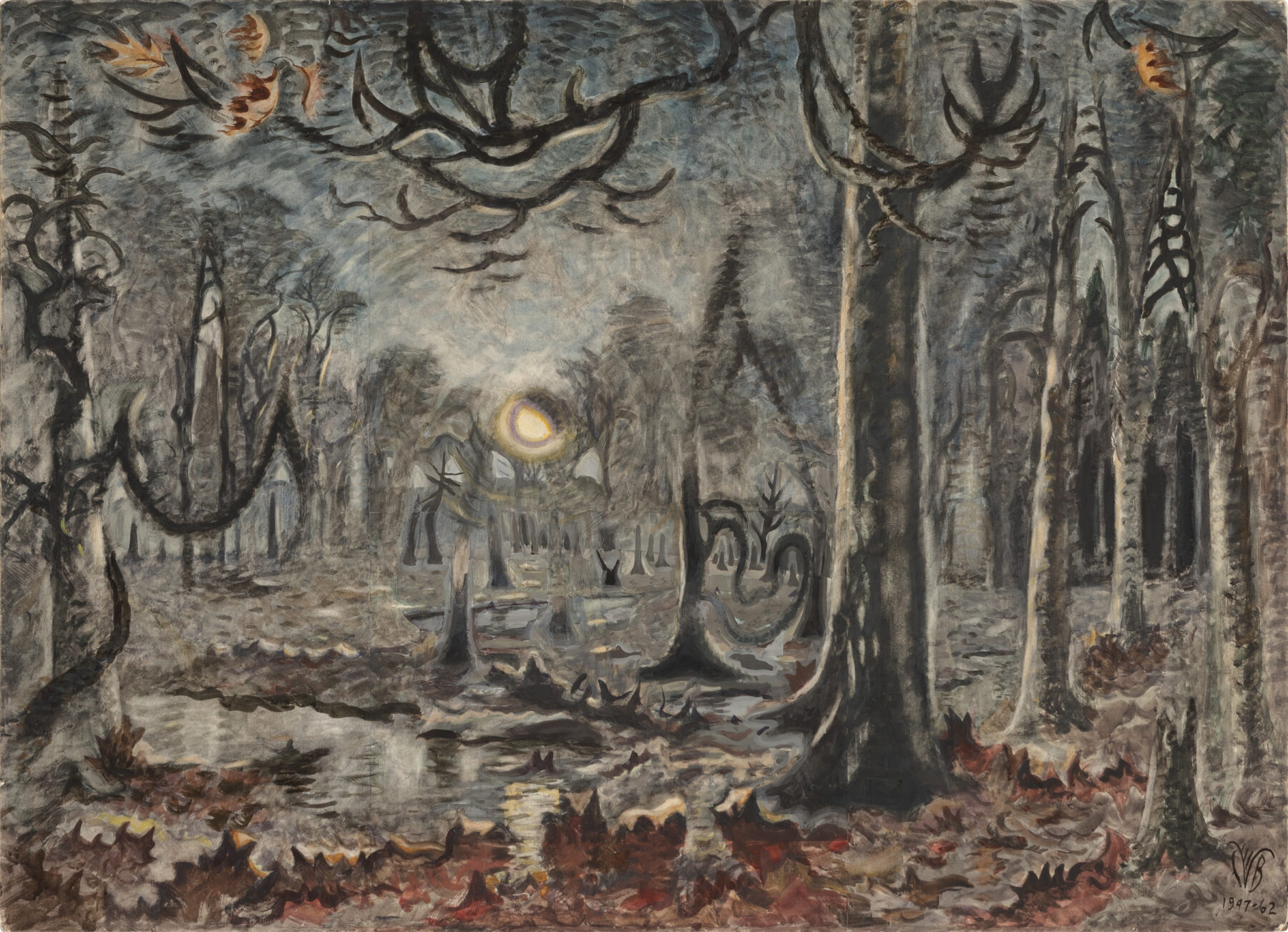
Reproduced with permission of the Charles E. Burchfield Foundation, courtesy of the Burchfield Penney Art Center
Charles Burchfield
Born in Ashtabula Harbor, Ohio, in 1893 and raised in Salem, he studied at the Cleveland School of Art, where he developed a highly personal visual language grounded in the rhythms, sounds, and moods of the natural world. His early watercolors transformed ordinary woods, fields, and houses into animated environments, charged with symbols of emotion and spiritual presence. After moving to Buffalo in 1921, he worked as a wallpaper designer and turned increasingly toward the streets, industrial architecture, and regional landscape of western New York. Although these paintings brought him national recognition, his ambitions extended far beyond the descriptive conventions of American Scene painting.
Burchfield’s stature was established early. In 1930, the Museum of Modern Art presented Charles Burchfield: Early Watercolors 1916–1918, its first one-person exhibition devoted to an artist. His work would later be the subject of major museum retrospectives, including exhibitions at the Albright Art Gallery and the Whitney Museum of American Art. Yet his most extraordinary achievement came not in his youth, but through a profound artistic renewal beginning in the 1940s.
Around 1943, Burchfield returned to the imaginative freedom of his earliest work. He began revisiting earlier watercolors, sometimes attaching carefully fitted sheets or strips of paper to extend a composition beyond its original boundaries. He could enlarge the sky, deepen a forest, or expand the space surrounding a central motif; he also cut away passages that no longer served his vision. These works, often called “reconstructions” or “two-period pictures,” were neither simple enlargements nor mechanical revisions. They were ambitious new paintings, conceived across decades and reimagined on a scale capable of conveying the immensity of nature.
The resulting mature watercolors of the 1940s, 1950s, and 1960s are widely regarded as the culmination of Burchfield’s art. Their often-monumental dimensions, complex surfaces, and heightened color dissolved the boundary between observation and memory. Weather, light, vegetation, and sound became expressions of an interior world. At a moment when Abstract Expressionism was reshaping American painting, Burchfield pursued an equally audacious but entirely independent language of emotional and spiritual intensity.
Executed over the extended period from 1947 to 1962, Moonrise in November Woods (Moonlight in the Woods) belongs to this exceptional late phase. Its unusually expansive format places it within the ambitious scale of Burchfield’s mature watercolor practice. The double date speaks to the sustained development of an idea rather than a fleeting record of a particular moment: for Burchfield, a landscape could be revisited, intensified, and brought into closer alignment with remembered sensation and imaginative experience.
The subject of moonlight in a November woodland is especially resonant within Burchfield’s art. The waning season, the density of the trees, and the elusive illumination of the night suggest a world poised between the visible and the unseen. Such themes allowed him to move beyond conventional landscape description toward an evocation of nature as a living, mysterious presence. In his mature vision, the forest is not merely scenery; it becomes a setting for contemplation, apprehension, and wonder.
Burchfield’s late landscapes are prized for their rare fusion of technical invention, expressive ambition, and deeply personal symbolism. They represent the mature realization of concerns that had animated his work since adolescence, now enlarged by decades of observation and reflection.
Moonrise in November Woods (Moonlight in the Woods), 1947-62
Watercolor on paper mounted on pulp board 39 1/8″ x 54″
Signed and dated lower right
Charles R. Penney, Olcott, New York, 1964
James Goodman Gallery, New York
Private Collection, New York, acquired from the above in the early 1990s
