©2026 Estate of John Marin / Artists Rights Society (ARS), New York
John Marin
John Marin played an important role in the development of American modernism. Born in Rutherford, New Jersey, in 1870, he studied at the Pennsylvania Academy of the Fine Arts and the Art Students League before spending formative years in Europe. His long association with Alfred Stieglitz placed him at the center of the American avant-garde, alongside Arthur Dove, Marsden Hartley, and Georgia O’Keeffe. Although Marin built his early reputation as a master of watercolor, by the 1930s he had returned with increasing commitment to oil. The paintings of his final decade – particularly the Maine oils of the 1940s and early 1950s – are now recognized among the most advanced works of his career.
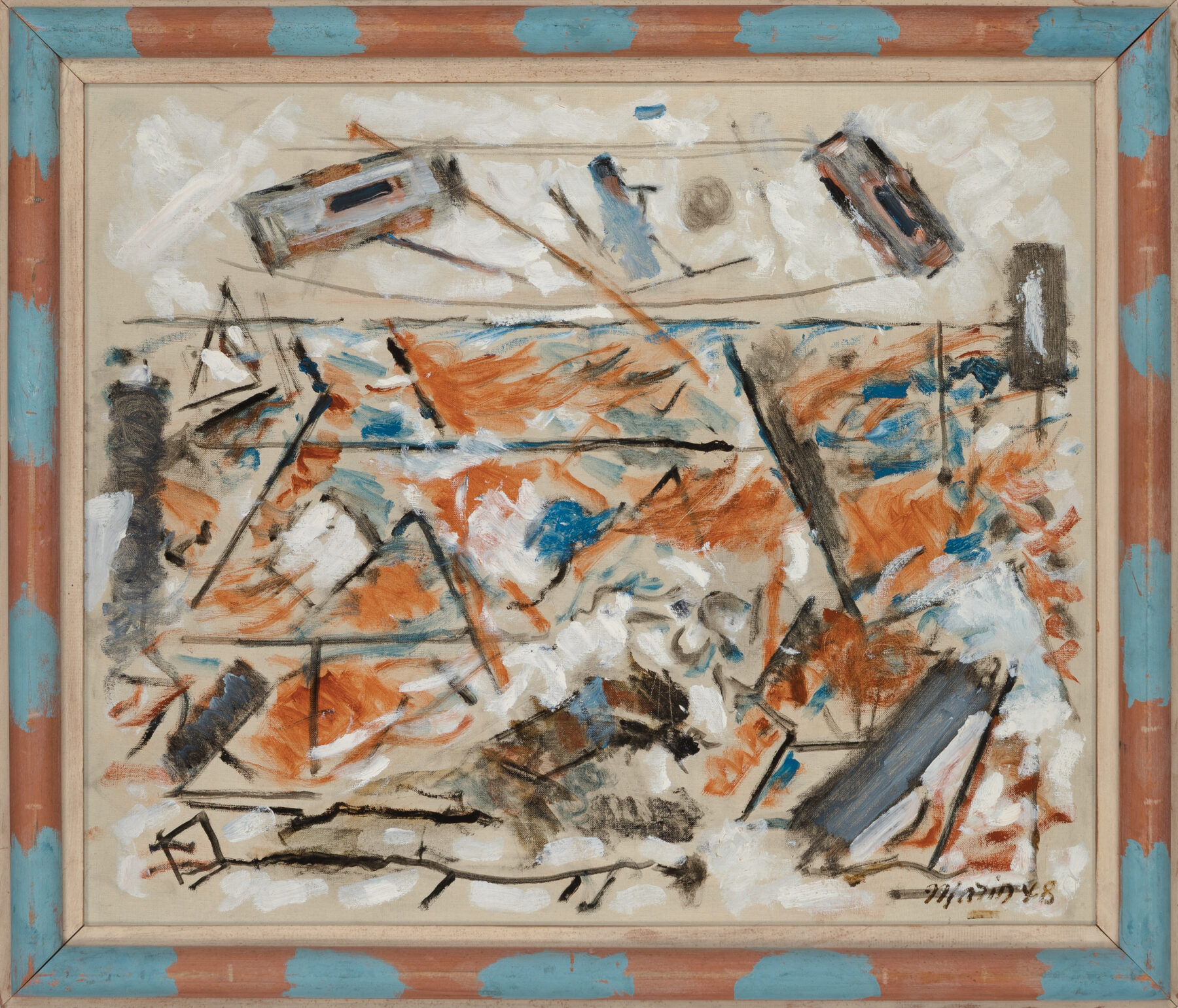
Sea in Greens, Red and Umber, 1948 belongs to this exceptional late period. For decades the Maine coast had provided Marin with one of his most enduring subjects, but in these late canvases’ observation is transformed into something increasingly abstract and immediate. Sea, rock, wind, and sky become catalysts for an energized language of color, line, and gesture. In the present work, greens, reds, and earthy umbers move forcefully across the canvas, while the active brushwork and passages of open ground give the composition an unusual sense of vitality. Marin was no longer simply depicting the sea; he was translating its force and movement into paint.
On February 3, 1948, Look magazine published a survey asking museum directors, curators, and critics to nominate America’s leading painters. The nominated artists then voted among themselves, and Marin emerged as “Artist No. 1.” At seventy-seven, he stood at the height of his reputation precisely as a younger generation of New York painters was redefining American art.
Marin’s late oils are especially important in this context. Their open surfaces, calligraphic line, compressed space, and increasingly physical handling of paint anticipate central concerns of Abstract Expressionism. His Maine paintings have long been discussed in relation to Jackson Pollock and Willem de Kooning; in 1950, painter and critic Louis Finkelstein specifically compared Marin’s late oils with de Kooning’s. The National Gallery of Art has likewise emphasized the relationship between Marin’s gestural late work and the emerging New York School. Marin remained rooted in nature, but his increasingly liberated approach helped establish a distinctly American path toward abstraction.
Sea in Greens, Reds and Umber is further distinguished by the survival of its original Marin-painted frame. Marin considered the frame an active extension of the composition, often carrying color and gesture beyond the canvas itself. Its presence preserves the work as a unified object conceived by the artist and materially strengthens its significance.
Sea in Greens, Reds and Umbers, 1948
Oil on canvas
22″ x 28″
Signed and dated lower right
In the artist’s original hand-painted frame, 28″ x 34″ overall
Private Collection
Kennedy Galleries, New York
Private Collection, New York, acquired from the above in the early 1980s
