©2026 The Educational Alliance, Inc. / Estate of Peter Blume / Artists Rights Society (ARS), NY
Peter Blume
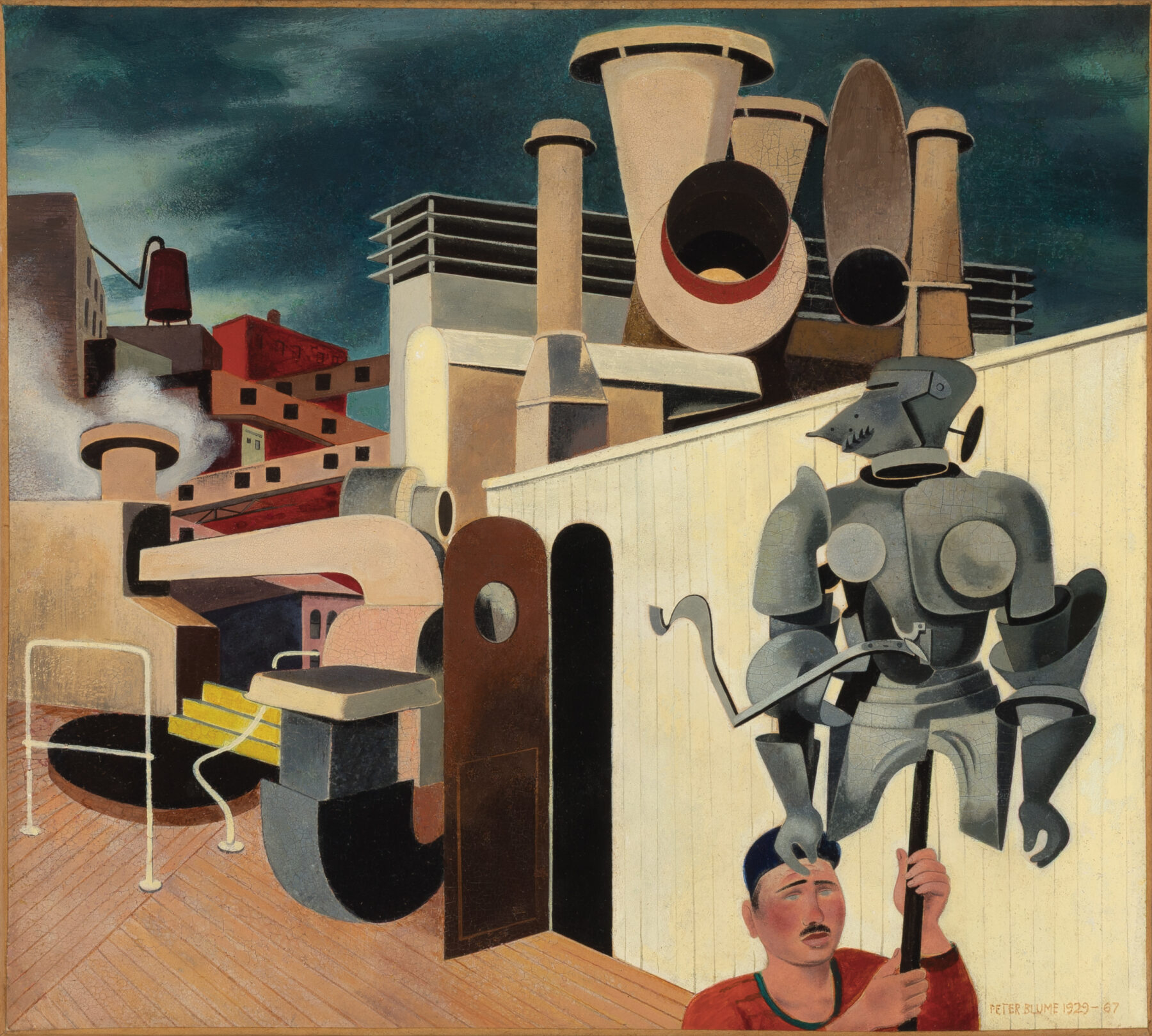
This sketch rehearses the full composition for Parade (1929-30) which was Peter Blume’s largest and most complex painting to date. It marked a creative breakthrough for the artist and initiated a way of working that guided him for the next decade. Blume devised it using what he called a “conceptual method” of seamlessly combining disparate observed scenes into a single contiguous whole. He debuted the painting and its studies in his first solo exhibition at the Charles Daniel Gallery in January, 1930. Museum of Modern Art (MoMA) co-founder, Abby Aldrich Rockefeller purchased the finished painting on director Alfred H. Barr, Jr.’s advice and donated it to the museum in 1935. Still jarring today, the image stood out from the work of Blume’s contemporaries through its uncanny integration of abstraction, industrial architecture, and an enigmatic figure carrying a suit of armor hoisted on a pole. Blume’s painting used the visual language of Surrealism nearly two years before the first survey of the movement in the United States.
While living in Manhattan, Blume became fascinated with the industrial buildings, factories, ships, and dockyard machinery along the edge of New York Harbor. He obtained a pass so he could wander freely and sketch on the decks of anchored vessels. Some buildings along the waterfront were vacant and nearby tenement buildings had recently been torn down. Blume liked the combination of modern machinery and the area’s eerie atmosphere. Back in his studio he made small paintings of buildings seen from a ship’s deck and another focused on the large ventilator juxtaposed with a floating armored head (these are in the collections of MoMA and the Museum of Fine Arts, Houston).
As the composition began to materialize in his mind, Blume structured it around an empty industrial space that fit with the era’s obsession with the machine and its related aesthetics. His contemporaries, such as Charles Demuth (Paquebot, “Paris”, 1921-22; Columbus Museum of Art) and Charles Sheeler (Upper Deck, 1929; Harvard Art Museums), had made paintings based around a ship’s ventilator as a focal point. Blume felt his picture needed something more. One day he had a sudden flash of inspiration. At the time Blume had been drawing suits of armor at the Metropolitan Museum of Art and thought they rhymed with industrial machinery. He was fascinated by their startling presence and “the way art and utility…were reconciled.” When his friend, the writer Malcolm Cowley, visited him in his studio, Blume saw the missing element; a man walking with a suit of armor held aloft. He asked Cowley to pose holding a ruler, sketched his friend’s hands and later completed the rest from memory. The present composition is the only known study of Cowley carrying the armor.
Blume enjoyed that this detail added narrative dissonance to the painting. He never explained whether it had a specific meaning, preferring to leave it mysterious and open-ended. Blume recalled, “There was a tremendous preoccupation at the time with the menace of the machine…Poets and painters were somehow aware of the fact that it was encroaching upon them in a very menacing way. A good deal of this rubbed off on my [painting].” Is the man protesting on behalf of workers’ rights? Is he a puppeteer? Is he transporting the armor to an exhibition? Is he under the spell of the metal body? We do not see where he is headed, and only have access to part of his body. His expression is dispassionate and unperturbed, as though this task is an ordinary part of his day. Placed in this industrial context, the armor appears fantastic, animate, menacing, like a modernist automaton. Parade was, after all, conceived two years after the release of Fritz Lang’s Metropolis, an early example of the anxiety arising from machines, an automaton, and a need for better labor conditions.
Blume repeatedly told interviewers that Parade was significant in part because of how it transformed his working method. It required a slow, contemplative method of putting incongruous parts together. Blume considered this act of combining disparate parts to be the creation of a “new world of experience. The method was really an extension of abstract painting with the addition of pictorial images, used and manipulated like forms and color. While this was all very much ‘in the air’ at the time it had roots and substance in my convictions.” In a statement made in 1954 about the creative process he emphasized:
“The genesis…of a picture I can trace back to accumulated personal experiences of things seen or imagined, to fascinations with certain shapes or textures, or to a preoccupation with a type of activity. The manner in which this falls together into a single concept of a picture is entirely unpredictable. The fusion forms a clear image in my mind. It may come at odd times and under varying circumstances (always away from the studio), precipitated by a glow of light in the city, the deep shade of the woods, or it may come suddenly in the middle of the night. Light, or the absence of it, seems to be the catalyst.”
Parade represented a convergence of ideas for the young artist. Blume was twenty-three years old when he competed the painting and part of a wide social circle that included writers, artists, and musicians centered on café and speakeasy culture in Greenwich Village. He had seen their work, frequented galleries and studios, but imagined a synthesis of realism and abstraction that appeared to be heretical. It was exactly this approach to form and content that set him apart and attracted the attention of the Surrealist group. Philippe Soupault, pioneer of automatic writing, and friend of Surrealism’s founder, André Breton, wrote about Blume for a French journal in 1932, reproducing Parade and South of Scranton (1930-31; Metropolitan Museum of Art). Blume maintained that his work was not rooted in the unconscious but involved a “conceptual method” of taking lived experience and arranging it at will. He explained late in life,
“My realism is not real, I mean, it’s realism on another level altogether. It’s ‘real’ but it has nothing to do with a photograph. It’s not what anybody else sees, it’s only what I see…Not even what I see but what I think ought to go into something to make it ‘real’…Realism is something that you put down as belonging only to the world that you’ve created within that area that you’ve chosen. And if it’s real there, then it’s real, reality doesn’t exist outside of it.”
In Parade Blume first worked out how that method could make a cohesive, powerful picture. The large finished painting relied on the artist’s careful consideration of its component parts, and the present study was an essential step towards that new vision.
Written by Robert Cozzolino
Independant curator and art historian
Minneapolis
Composition Study for Parade, 1929-67
Mixed media and tempera on board
13 1/2″ x 15 3/4″
Signed and dated lower right
The artist
Kennedy Galleries, Inc., New York
Private Collection, New York, acquired from the above in the early 1980s
